|
 |
Introduction to TCM

Basics of TCM
• Yin-Yang | Five Elements
Zang-Fu Theories
• Zang Organs | Fu Organs
Classification of Antineoplastic Herbal Medicines
Characteristics of Herbal Medicines
Diagnose
• By Auscultation & Olfaction
• By Inspection
Prescriptions
Theories of Channels (Meridians) and Collaterals
Reference: A Modern View of the Immune System
Differentiation of Syndromes
• 8 Principles
• 6 Channels 4 Stages
• Syndromes of Zang-Fu Organs
Etiology
• Exogenous
| Pestilential
• Pathogenic Factors
• Emotional
Materia Medica
Back to Home
|
|
Hand/Wrist Pulse Feeling
In traditional Chinese medicine the pulse is considered as having
three divisions : cun, guan, and chi. A normal pulse is neither
superficial nor deep, neither quick no slow, and it beats in medium
frequency, i.e., 4-5 beats per breath, with a regular rhythm.
To feel the pulse correctly, place the patients hand comfortably
on a cushion with the palm facing upward. First, the practitioner
should put their middle finger on the guan division, then the index
and ring fingers should naturally fall on the cun and chi divisions.
Finger force should at first be light, then moderate and finally heavy
to get a general picture of the depth, rhythm, strength, and form of
the pulse. An even force should be applied on the three regions.
Through comparisons of the three regions, the practitioner can gain
a correct impression of the pulse as a whole. A normal pulse is of
moderate frequency, i.e., 4-5 beats per breath, regular rhythm, even
and forceful.
The following are abnormal pulses commonly seen in the clinic:
Floating Pulse (fumai)
When the pulse is pressed lightly it appears under the finger, and
when pressed heavily it becomes weak. It often occurs in the early
stages of diseases caused by exogenous pathogenic wind cold and heat,
i.e., exterior syndromes. If it is seen in patients who are suffering
from prolonged chronic diseases, it indicates a dangerous site where the
yang qi of the body flows outward.
Deep Pulse (chimai)
No clear pulse is felt by superficial pressure, only by heavy pressure.
This indicates an interior syndrome.
Rapid Pulse (sumai)
The pulse beats rapidly at a rate higher than the normal 5 beats per
breath (i.e., more than 90 times per minute). This indicates a heat
syndrome.
Xu Type Pulse (xumai)
If the pulses of the three regions are weak and forceless, this indicates xu type syndromes. These are mostly caused by both qi and blood deficiencies and are seen during the process of chronic diseases.
Shi Type Pulse (shimai)
If the pulses of the three regions are forceful with both light and heavy pressure, shi type syndromes are present.
Slippery pulse (huamai)
If the pulse is smooth and flowing, like a pearl rolling on a plate, this indicates excessive phlegm, retention of food, or shi heat type syndromes.
Rough Pulse (semai)
This pulse is uneven and has a roughness similar to scraping bamboo with a knife. It indicates a deficiency of blood and essence, qi stagnation, and blood stasis.
Fine Pulse (ximai)
This pulse is as fine as a silk thread, and indicates exhaustion of qi and blood.
Full Pulse (hongmai)
This pulse beats like a dashing wave, with one rising wave following another. It indicates excessive heat.
Wiry Pulse (xuanmai)
This pulse is straight and long, like a tremulous music string, seen usually in diseases of liver, gall bladder, pain, or phlegm-humor.
Tense Pulse (jinmai)
The pulse is taut and forceful, like a tightly stretched cord, and occurs in diseases caused by cold, pain, or retention of food.
Hollow Pulse (koumai)
This pulse is floating, large, and empty inside, feeling like a scallion stalk. It indicates a massive loss of blood and essence.
Hesitant Pulse (cumai)
This pulse is rapid with irregular intermittent beats. It indicates excessive yang and shi heat, qi stagnation, pathogenic phlegm mixture with cold, blood stasis, etc.
Knotted Pulse (jiemai)
This pulse is slow and uneven with irregular intervals. It indicates excessive yin, qi stagnation, pathogenic phlegm mixture with cold, blood stasis, etc.
Intermittent Pulse (daimai)
This pulse is slow with regular intervals. It indicates qi exhaustion of the zang organs, or syndromes of wind and pain caused by emotional pathogenic fright and fear.
Read more on Body Pulse.
|

|
|
|
|
|
|
|
|
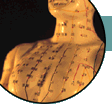
WHAT IS TRADITIONAL CHINESE MEDICINE?

Photo © Image DJ Image Dictionary
With over 3000 years of experience, Traditional Chinese Medicine (TCM) has
remain one of the many fascinating areas in ancient Chinese culture.
First known to be documented in the Yellow Emperor's Canon of Medicine,
TCM is believed to have been practised in as early as 475 to 221 B.C.
The field of working knowledge of TCM stretches from anything related to
general healthcare practice to the philosophy of the mind, the logic of life,
religion, and even to as far as cosmology and astronumerology. This is why
in order to thoroughly understand the concepts behind TCM, one must be
comprehensive in learning and embracing the Chinese culture as a whole.
Just as Douglas Hoff put it when he explained about accupuncture, "The systems
of TCM uses the concepts of elements and meridians and are completely immersed
in the Asian cosmology which takes shape through the religions." The meridian-brain mechanism,
the fundamental working concept of acupuncture, in which the pain block from the message
that the needle or burning cone of herbs gives to the point of stimulus,
was only found centuries later by the West through science and technology.
|
| |
|
MESSAGE FROM THE EDITOR – MARCH 2020
 Thank you for visiting this TCM and acupuncture information website.
If you have previously been to this website, you might have
noticed that some of the pages on ancient historical ideas and
holistic thinkings related to Chinese metaphysics are temporarily taken offline.
This is because I will be revamping the whole website and be moving
those information into a new \"Ancient Chinese Culture\" section
so as to reflect a more current perspective on the interpretation
of some of the fundamental concepts as well as to include
some of the latest information in the area.
But if you have just found this website for the very first time, I welcome you again and
wish you could find what you require and, hopefully, you could also be benefitted
from reading the articles I published on this website.
Thank you for visiting this TCM and acupuncture information website.
If you have previously been to this website, you might have
noticed that some of the pages on ancient historical ideas and
holistic thinkings related to Chinese metaphysics are temporarily taken offline.
This is because I will be revamping the whole website and be moving
those information into a new \"Ancient Chinese Culture\" section
so as to reflect a more current perspective on the interpretation
of some of the fundamental concepts as well as to include
some of the latest information in the area.
But if you have just found this website for the very first time, I welcome you again and
wish you could find what you require and, hopefully, you could also be benefitted
from reading the articles I published on this website.
Please be patient and do come and check out this website frequently as it's being revamped.
Raymond Cheng, PhD DPA FRSA FRSPH
March 28, 2020.
|
|
|
IMPORTANT NOTICE AND DISCLAIMER
 This website is published, edited and designed by Raymond Cheng,
and reflects only and only his personal views and opinions in his individual capacity.
The information available at this website is not intended
directly or by implication to either diagnose or treat any
medical, emotional, or psychological condition or disorder.
It is also not intended to create a physician-patient relationship
between you and I or between you and Wyith Institute™ and The Office of Dr Raymond K K Cheng.
The information here is not a substitute for advice and treatment provided
by your physician or by another healthcare professional.
It is always recommended that consultation with local healthcare providers
be obtained for any of your specific health or medical concerns.
Furthermore, any products that can be purchased (yet you can see I don't have much
to sell here) through advertisers' banners or through links to other websites
are not either explicitly or implicitly given any warranty or endorsement
by me, my colleagues, Wyith Institute™ or any of its associated businesses.
This website is published, edited and designed by Raymond Cheng,
and reflects only and only his personal views and opinions in his individual capacity.
The information available at this website is not intended
directly or by implication to either diagnose or treat any
medical, emotional, or psychological condition or disorder.
It is also not intended to create a physician-patient relationship
between you and I or between you and Wyith Institute™ and The Office of Dr Raymond K K Cheng.
The information here is not a substitute for advice and treatment provided
by your physician or by another healthcare professional.
It is always recommended that consultation with local healthcare providers
be obtained for any of your specific health or medical concerns.
Furthermore, any products that can be purchased (yet you can see I don't have much
to sell here) through advertisers' banners or through links to other websites
are not either explicitly or implicitly given any warranty or endorsement
by me, my colleagues, Wyith Institute™ or any of its associated businesses.
|
|
|
|